

Why Ridesharing? Why Now?
We source our investment ideas based on parameters built into our Watch List. They are:
- Thematic Exposure
- Magnitude of Revenue Growth expectations built into the stock price
- Scalability or Operating Leverage built into the business.
Well, it turns out that Uber and Lyft rank well based on these dimensions, and so we decided to take another look. Here’s a snapshot of our Watch List.
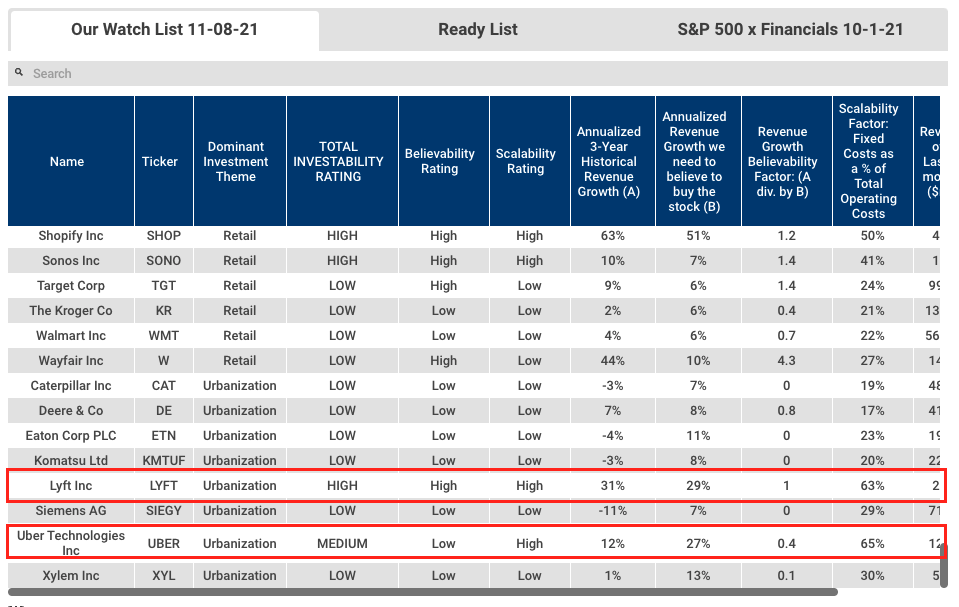
The theory behind our Investability Ratings in plain English is this: Let’s find investment candidates that don’t have ridiculous revenue expectations built into their price AND have a lot of Operating Leverage – companies/stocks with these attributes are likely to be underpriced by Mr. Market, and therefore present the highest chances of netting us a decent return. Of course, the underlying assumption is that Mr. Market’s emotional pendulum with regard to any individual stock often swings between pessimism and exuberance – occasionally passing through the “zone of reason”.
Operating Leverage kicks in only if revenue grows. While the chances of that happening over the long-term are high, given the broad themes of megatrends within which we scan the world, a lot depends on basic, fundamental things like:
- The company’s competitive advantage
- Durability of the competitive advantage
- Growth Strategy
For Uber and Lyft, we’ll dig into some of these attributes, but this article is mostly a numerical exercise about “what we need to believe to invest in these companies”. Essentially, we’ll break down Uber and Lyft’s Investability Ratings into its components.
We’ll start with where these companies stand financially today, and then move on to Price and Volume variables, Strategy and finally a definitive course of action.